
For the vast majority of men, a receding hairline has one root cause: androgenetic alopecia — male pattern baldness driven by the hormone DHT acting on genetically predisposed follicles. Understanding this mechanism is more useful than looking for a simple fix.
The Primary Cause: DHT and Follicle Miniaturization
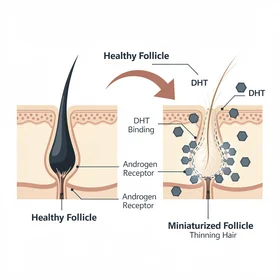
DHT (dihydrotestosterone) is a potent androgen derived from testosterone via the enzyme 5-alpha-reductase. In men with a genetic susceptibility, DHT binds to androgen receptors in follicles along the frontal hairline and temples — areas that are particularly sensitive to this hormone.
Over time, repeated DHT exposure causes these follicles to miniaturize: each successive hair growth cycle produces a slightly shorter, finer hair. Eventually the follicle produces only fine, unpigmented vellus hair, and then goes dormant. The result is what you see as a receding hairline.
The reason this typically starts at the temples first is that frontal and temporal follicles tend to have higher androgen receptor sensitivity than follicles elsewhere on the scalp. The vertex (crown) is also susceptible, which is why many men lose both the hairline and the crown simultaneously. For a detailed walkthrough of the full DHT pathway and how genetic sensitivity determines outcomes, DHT Hair Loss covers the biology in depth.
The Role of Genetics
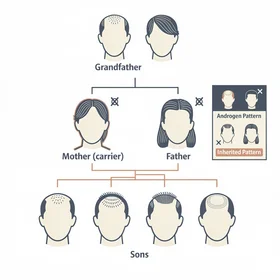
Genetic susceptibility is the deciding factor. Two men can have identical DHT levels — one loses his hairline in his 20s, the other keeps a full head of hair into his 60s. The difference lies in how their follicle androgen receptors are programmed to respond to DHT.
This susceptibility is polygenic — influenced by many genes, not a single one. It's commonly said to come from the maternal grandfather, and while the X-linked androgen receptor gene (inherited from the mother) plays a significant role, paternal genetics matter too. If both your father and maternal grandfather experienced hairline recession, your odds are higher than if only one did.

Male pattern baldness typically becomes noticeable between ages 20 and 40, though the timeline varies widely based on genetics.
Age and Onset
Androgenetic alopecia can begin as early as the late teens, though most men first notice it in their 20s or 30s. The rate of progression varies significantly. Some men experience rapid recession over a few years; others have gradual recession that takes decades to reach a significant stage.
By age 50, roughly half of men show visible hair loss. By 70, that figure is closer to 80%. The age of onset is somewhat predictive of eventual severity — men who start losing their hairline earlier tend to experience more extensive loss overall.
Other Contributing Factors
While DHT and genetics are the primary drivers, a few other factors can accelerate the timeline:
- Stress — Telogen effluvium (stress-related shedding) doesn't cause permanent hairline recession, but can accelerate existing androgenetic alopecia
- Nutritional deficiencies — Iron, zinc, and biotin deficiencies can impair hair growth, though correcting them typically doesn't reverse androgenetic alopecia
- Scalp health — Chronic inflammation from seborrheic dermatitis or dandruff may compound DHT-related follicle sensitivity in some men
- Medications — Anabolic steroids and certain other drugs can accelerate androgenetic alopecia in susceptible men
What Doesn't Cause a Receding Hairline
Wearing hats does not cause hair loss. Frequent shampooing doesn't accelerate recession. High testosterone doesn't directly cause hairline recession — it's the conversion to DHT and the follicle's sensitivity to it that matters. A man with low testosterone can still go bald.
Understanding the cause is the first step. Next, learn how to identify your stage on the Norwood scale — because the stage determines which treatments are most effective.