
The Norwood scale (also called the Hamilton-Norwood scale) is the standard classification system for male pattern baldness. It describes seven stages of progression from a full hairline to extensive hair loss — and identifying your stage is the starting point for making informed decisions about treatment.
The Seven Norwood Stages
Stage I — No significant recession. The hairline sits at or slightly above the upper forehead creases. This is considered the baseline for a mature hairline.
Stage II — Slight recession at the temples, forming a mild M-shape. Many men settle here and progress slowly. This is the earliest stage where intervention makes a meaningful difference.
Stage III — The first stage clinically classified as baldness. Temple recession deepens noticeably. Some men in Stage III also show early thinning at the vertex (Stage III Vertex).
Stage IV — Significant frontal recession with a band of hair separating frontal loss from vertex thinning. The two zones haven't yet merged.
Stage V — The band separating frontal and vertex thinning narrows. The two zones begin to appear connected.
Stage VI — The bridge between frontal and vertex zones is gone. Hair loss across the top of the scalp is extensive.
Stage VII — The most advanced stage. Only a horseshoe-shaped band remains around the sides and back. The top of the scalp is completely bald.
Why Stage Matters for Treatment
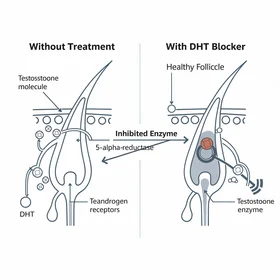
DHT blockers work by preserving follicles that are still active — they cannot restore follicles that have fully miniaturized and gone dormant.
- Stages I–III: Most responsive to DHT-blocking intervention. Preserving the existing hairline is realistic; some regrowth possible in still-active follicles
- Stages IV–V: Slowing further progression is realistic; partial regrowth possible but less predictable
- Stages VI–VII: DHT blockers can stop further loss but significant density restoration is unlikely without hair transplant surgery
The Mature Hairline vs. Pathological Recession
Between adolescence and the mid-20s, most men's hairlines naturally mature — moving slightly backward from the juvenile hairline. This is normal. A maturing hairline recedes evenly and stabilizes. A receding hairline driven by androgenetic alopecia shows asymmetric temple deepening, miniaturization of hair at the edge, and doesn't stabilize — it progresses over time.
How to Evaluate Your Receding Hairline Stage
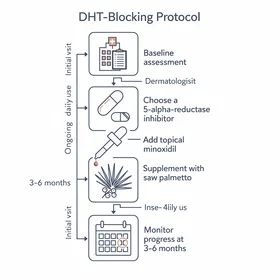
Getting started with an honest self-assessment is the first step toward choosing the right approach. Follow these steps to identify where you stand on the Norwood scale:
- Step 1: Take baseline photos. Use a well-lit bathroom with consistent overhead lighting. Take photos from directly above (crown), from the front (hairline), and at a 45-degree angle from each side (temples). Use the same phone position each time for future comparison.
- Step 2: Examine the recession pattern. Look at the depth of temple recession. Is it symmetric or deeper on one side? Are the temple points forming a clear M-shape, or is it a flat, even recession?
- Step 3: Check for miniaturization. Look closely at the hairs along the recession edge. If they are fine, thin, and lighter in color compared to the thicker hair behind them, that is active miniaturization — a sign of ongoing DHT-driven loss rather than a stabilized mature hairline.
- Step 4: Assess the crown. Part your hair at the crown and check for visible scalp. Crown thinning often accompanies hairline recession but progresses independently.
- Step 5: Compare to the Norwood scale. Match your photos to the seven Norwood stages described above. Most men underestimate their stage by one level — be honest with yourself.
- Step 6: Confirm with a professional. A dermatologist with a dermoscope can measure follicle diameter ratios and definitively confirm your stage. This step is especially important before starting prescription treatment or considering surgery.
Once you know your stage, see our treatment options page for evidence-based recommendations matched to each Norwood level. For a broader perspective on what reversal looks like at each stage, recedinghairline.org covers the clinical data.